
Gear Ratio Calculator
A gear ratio tells you how many turns the input makes for each turn of the output — and therefore how speed and torque trade off. This calculator handles three common cases: gear trains (one or two stages), bicycle chainrings and cogs, and car or motorcycle gearing from engine RPM to road speed.
- Free to use
- No sign-up
- Runs in your browser
Gear ratio calculator
Gear Charts Pack
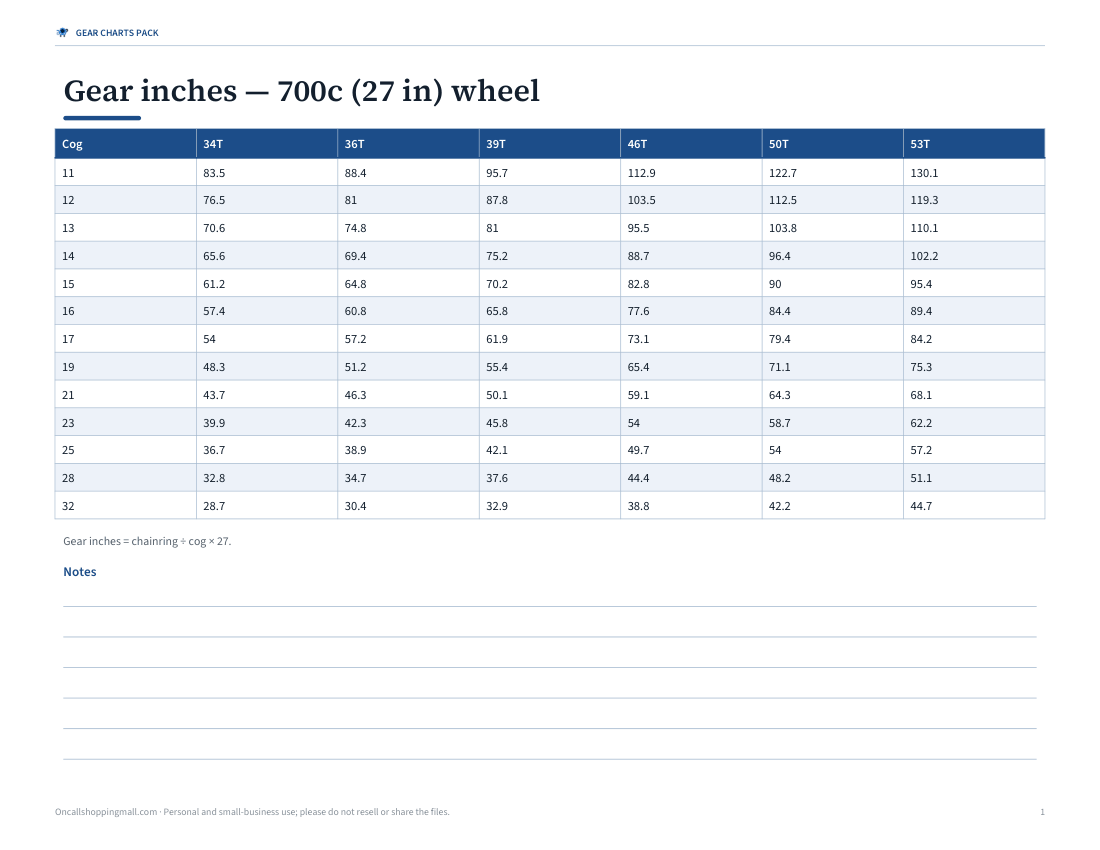
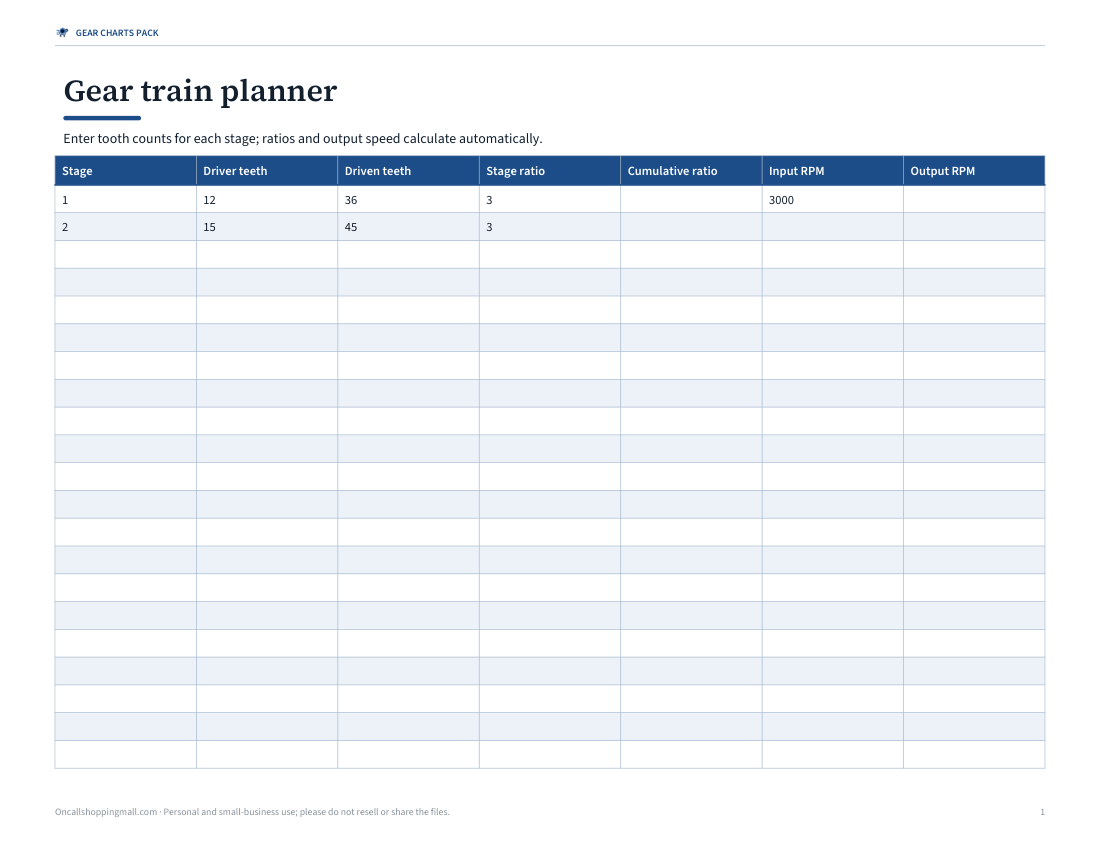
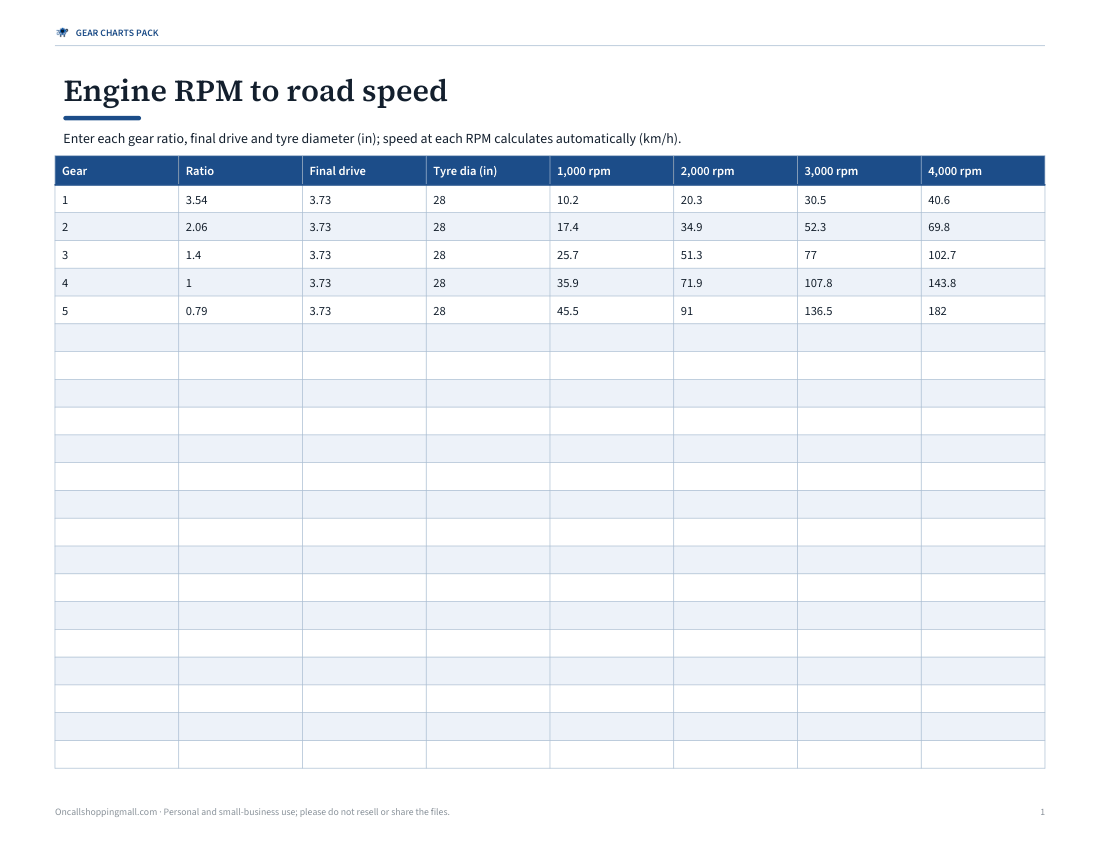
Printable bicycle gear-inch chart, a gear train planning worksheet, an RPM-to-speed chart template for vehicles and a gearing log.
- Gear-inch chart (PDF/XLSX)
- Gear train planner (XLSX)
- RPM–speed chart (XLSX)
- Gearing log (PDF/DOCX/XLSX)
Formats: PDF, XLSX, DOCX. Instant download after payment (link valid 72 hours, up to 5 downloads). AI-assisted: the templates were drafted with AI help and reviewed and laid out before publishing.
$5.00 USD, one-time 4 files · about $1.25 each
- Instant download
- 7-day refund
- Secure checkout by Stripe
7-day money-back guarantee. Full refund within 7 days of purchase, even after you download.
Free sample: Bicycle Gear Inch Chart (PDF, 54 KB)
Full refund within 7 days — see the refund policy and license.
Free printables
Single sheets you can print right now, no sign-up. The full pack adds every sheet in one download plus the editable files.
 Printable Gear-Inch Chart
 Printable Gear Train Planner
 Printable RPM to Speed Chart
 Printable Gearing Change Log
What a gear ratio is
The gear ratio is the number of teeth on the driven (output) gear divided by the teeth on the driver (input) gear. A 12-tooth gear driving a 36-tooth gear has a 3 : 1 ratio: the input turns three times for each turn of the output. The output turns three times slower but with about three times the torque (minus friction losses). A ratio below 1 is an overdrive — faster output, less torque.
Gear formulas
| Quantity | Formula |
|---|---|
| Ratio (one stage) | driven teeth ÷ driver teeth |
| Ratio (compound) | stage 1 ratio × stage 2 ratio × … |
| Output speed | input speed ÷ ratio |
| Output torque | input torque × ratio × efficiency |
| Bicycle gear inches | chainring ÷ cog × wheel diameter (in) |
| Bicycle development | gear inches × π × 0.0254 m |
| Road speed | engine RPM ÷ (gear × final drive) × tyre circumference |
Worked examples
| Case | Numbers | Result |
|---|---|---|
| Gear train | 12-tooth driving 36-tooth, input 3,000 RPM, 2 N·m, 97% efficient | 3 : 1, output 1,000 RPM, about 5.8 N·m |
| Bicycle | 50 × 17 on a 700c wheel (27 in), 90 RPM | 2.94 ratio, 79.4 gear inches, 6.33 m per turn, about 34 km/h |
| Car | 3,000 RPM in a 1.00 gear with 3.73 final drive, 28 in tyre | overall 3.73, about 804 wheel RPM, about 108 km/h (67 mph) |
These are the calculator’s defaults — change them to your own gears, bike or vehicle.
Idler gears and direction
Each pair of external gears reverses the direction of rotation. An idler gear placed between the driver and driven gear doesn’t change the overall ratio — its teeth cancel out — but it restores the original direction and can bridge a gap between shafts. Internal (ring) gears, belts and chains keep the same direction.
Bicycle gearing tips
- Around 60–70 gear inches suits steady riding on the flat for many riders; lower gears (under 40) help on steep climbs.
- Compare bikes with gear inches or development rather than tooth counts alone — wheel size matters.
- A “compact” road chainset (50/34) gives easier climbing gears than a standard 53/39.
- Keep a comfortable cadence (often 80–100 RPM on road bikes) and shift to maintain it.
- Single-speed and fixed-gear riders often choose around 65–75 gear inches for mixed riding.
Car gearing tips
A numerically higher final drive (for example 4.10 instead of 3.55) improves acceleration and towing but raises cruising RPM and fuel use. Larger tyres effectively lower the gearing — the speedometer reads low and acceleration drops — which is why off-road vehicles with big tyres often change their final drive. The calculator shows the RPM at 100 km/h or 60 mph so you can compare setups.
Speed, torque and power
Gears trade speed for torque but cannot create power. Power equals torque times rotational speed, so a 3 : 1 reduction gives three times the torque at one-third of the speed, and the output power is the same as the input minus friction losses. Spur gears typically lose a few percent per stage; worm gears can lose much more, especially at high ratios.
Gear types at a glance
| Type | Typical use | Notes |
|---|---|---|
| Spur | Parallel shafts, simple drives | Efficient, can be noisy |
| Helical | Car gearboxes, quiet drives | Smoother; creates axial thrust |
| Bevel | Shafts at an angle | Hand drills, differentials |
| Worm | High reduction in one stage | Often self-locking; lower efficiency |
| Planetary | Compact high ratios | Automatic gearboxes, bike hubs |
| Belt / chain | Distant shafts | Ratio = driven ÷ driver pulley or sprocket |
Chains and belts
Sprockets and pulleys follow the same rule as gears: ratio = teeth (or diameter) of the driven wheel ÷ teeth of the driver. Unlike meshing gears, a chain or belt keeps both wheels turning in the same direction. Bicycle drivetrains are chain drives, so the bicycle mode uses chainring and cog teeth in exactly this way.
Gear teeth and mesh
- Gears that mesh must have the same tooth size (module or diametral pitch).
- Very small gears (under about 12–13 teeth) may need profile shifting to avoid undercut.
- Choose tooth counts without a common factor (hunting tooth) to spread wear evenly.
- Plastic gears run quietly but carry less load than steel.
Gear charts pack
The optional pack includes a printable bicycle gear-inch chart for common chainrings and cogs, a gear train planning worksheet, an RPM-to-speed chart template for vehicles and a gearing log. The calculator above is free.
AI-assisted content
This page was drafted with AI assistance and reviewed before publishing. Results are ideal calculations; real systems include losses and tolerances.
Frequently asked questions
How do you calculate gear ratio?
Divide the driven gear’s teeth by the driver gear’s teeth.
What does a 3:1 gear ratio mean?
The input turns three times for each output turn, giving about three times the torque at a third of the speed.
What are gear inches?
Chainring ÷ cog × wheel diameter — a way to compare bicycle gears across wheel sizes.
How do I calculate speed from RPM?
Divide engine RPM by the overall ratio and multiply by the tyre circumference.
Does an idler gear change the ratio?
No, only the direction.
What is a final drive ratio?
The last reduction in a vehicle’s drivetrain, usually in the differential.
Does a higher gear ratio mean faster?
In gear trains, a higher ratio means slower output with more torque; in cars, a numerically higher final drive accelerates harder but tops out lower.
What is a good gear ratio for a single-speed bike?
Many riders like around 2.6–2.9, such as 46×17 or 48×18, for mixed terrain.